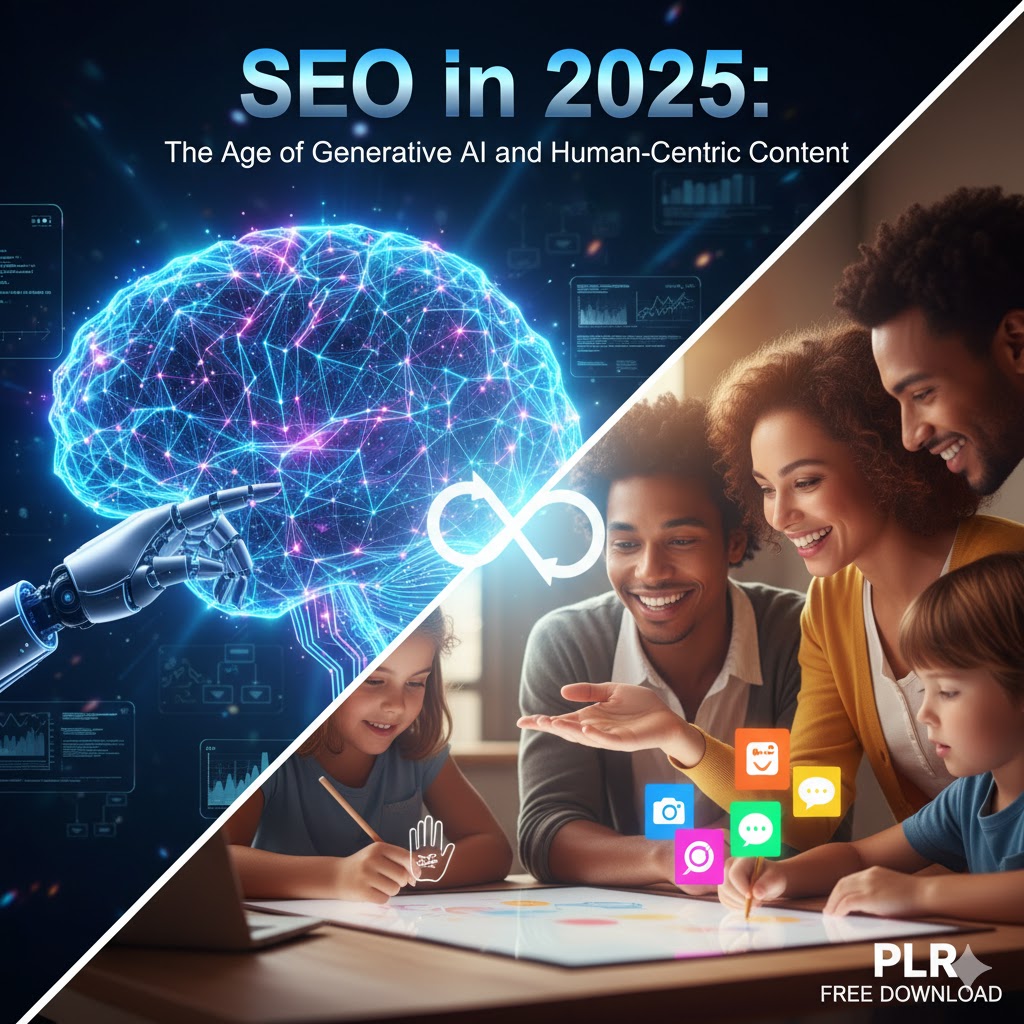

The year 2025 has cemented its place as a pivotal moment in the history of Search Engine Optimization. SEO is no longer a game of keyword density and link-building alone; it is a complex, human-first discipline dominated by Generative AI and an unparalleled focus on user experience.
The core message for every marketer and content creator is clear: Adapt or disappear. Google’s algorithms, supercharged by AI, are relentlessly prioritizing content that demonstrates genuine value, authority, and first-hand experience. This comprehensive guide breaks down the essential shifts that define SEO success right now in 2025.
The SERP Revolution: AI Overviews and GEO
The most visible change in the 2025 search landscape is the dominance of AI Overviews, the generative summaries (formerly SGE) that now appear at the top of a significant percentage of search results. These overviews, which provide instant, aggregated answers to complex queries, have fundamentally changed how users interact with the Search Engine Results Page (SERP).
Generative Engine Optimization (GEO)
Traditional SEO focused on earning the coveted “blue link” to secure organic clicks. In 2025, a new strategy is essential: Generative Engine Optimization (GEO).
- Objective: To position content so that it is included, cited, and prominently featured within the AI Overviews themselves.
- The Click-Through Rate (CTR) Reality: Early data confirms a decline in organic CTR for queries heavily featuring AI Overviews. The strategic response is not to fear the decline but to optimize for inclusion and ensure the AI summary encourages, rather than replaces, a click-through to your detailed, authoritative source.
- Optimization Tactics: Content must be concise, structured, and factually robust to be easily parsed and synthesized by Google’s large language models. This includes clear headings, detailed steps, embedded FAQs, and summary boxes.
🎖️ Content Quality: E-E-A-T and First-Hand Experience
Google’s continuous core updates throughout 2025 (including significant shifts in March and June) have doubled down on the Helpful Content System and the expanded quality framework of E-E-A-T (Experience, Expertise, Authoritativeness, and Trustworthiness). This is the algorithm’s defense against the flood of thin, unoriginal content created by early-generation AI tools.
The Experience Imperative
The ‘Experience’ component of E-E-A-T is no longer a soft factor—it’s a requirement. Google is rewarding content that:
- Demonstrates First-Hand Use: Writers must show they have actually used the product, visited the location, or carried out the process they are describing. This means incorporating original, non-stock photography, unique case studies, proprietary data, and personal narratives.
- Has Clear Authorship: Content must be attributed to an identifiable human expert with relevant credentials. Vague or anonymous author pages will struggle. Websites should use Author Schema Markup to validate the contributor’s expertise.
- Is Human-Guided, AI-Assisted: The era of mass-produced, unedited AI content is over. The winning formula in 2025 is blending AI efficiency (for structuring, research, and drafting) with human expertise (for originality, voice, and fact-checking). The content must reflect a genuine, authoritative voice.
Topic Clusters Over Keywords
SEO has officially transitioned from a keyword-centric approach to a topic-centric one. This involves implementing a Topic Cluster or Ranch-Style SEO strategy:
- Create Pillar Pages that broadly cover a central subject (e.g., “The Complete Guide to Solar Power”).
- Develop numerous, highly-targeted supporting articles that cover granular, low-volume sub-topics (e.g., “Calculating Solar Panel Tilt for Latitude 40°N”).
- Internal Linking: Use clear, contextual internal links to connect all supporting content back to the main Pillar Page, signaling to Google your comprehensive authority on the entire topic.
⚙️ Technical SEO: Speed, Stability, and Semantic Markup
While AI and content dominate the headlines, the technical foundation remains the crucial backbone of success. The focus on User Experience (UX) has only intensified.
Core Web Vitals (CWV)
CWV metrics are now a non-negotiable ranking currency. SEOs must maintain a laser focus on:
- LCP (Largest Contentful Paint): Ensuring the main content loads in under 2.5 seconds. This requires optimizing images, using efficient hosting, and leveraging Content Delivery Networks (CDNs).
- INP (Interaction to Next Paint): Keeping the latency of user interactions (taps, clicks) under 200 milliseconds for a smooth, lag-free experience.
- CLS (Cumulative Layout Shift): Preventing unexpected movement of page elements (like pop-ups or ads) that disrupt the user, keeping the score below 0.1.
Structured Data and Semantic SEO
Structured data (Schema Markup) is essential for bridging the gap between human language and AI understanding. By explicitly labeling your content—identifying a recipe, a FAQ, an author’s credentials, or a business’s local details—you make it easier for the AI Overviews to parse, cite, and feature your information. Semantic SEO—optimizing for the underlying meaning and intent of a query, not just the exact keywords—is what enables success in the GEO landscape.
📈 The Omnichannel Future: Beyond Google
Finally, SEO in 2025 recognizes that search happens everywhere. While Google remains the leader, a successful organic strategy must adopt OmniSEO principles:
- Vertical Search: Optimizing for Amazon (e-commerce), YouTube (video answers), and App Stores is critical, as these platforms increasingly act as the first-stop search engine for specific user intents (product research, entertainment, utility).
- Video Dominance: With nearly all internet users watching videos weekly, optimizing video content with descriptive titles, clear transcriptions, and relevant chapter markers is a vital part of a complete SEO strategy.
- Personalization: User intent is tracked and personalized more deeply than ever. Content strategies must segment audiences to deliver tailored experiences, dynamically adapting content based on user history or location, moving beyond a “one-size-fits-all” page.
💡 Conclusion: The Human Imperative
SEO in 2025 is ultimately a return to the fundamentals: serving the user. AI has not replaced the need for SEO; it has raised the barrier to entry. The only way to thrive is to be better than the mass-generated noise.
Focus your resources on:
- Originality and Experience: Create content that only you (or your expert) can create.
- Technical Excellence: Ensure your site is fast, stable, and easy to crawl.
- Structure and Clarity: Use semantic markup and clear formatting to feed the AI models.
The future of search is intelligent, generative, and rewards the human touch.