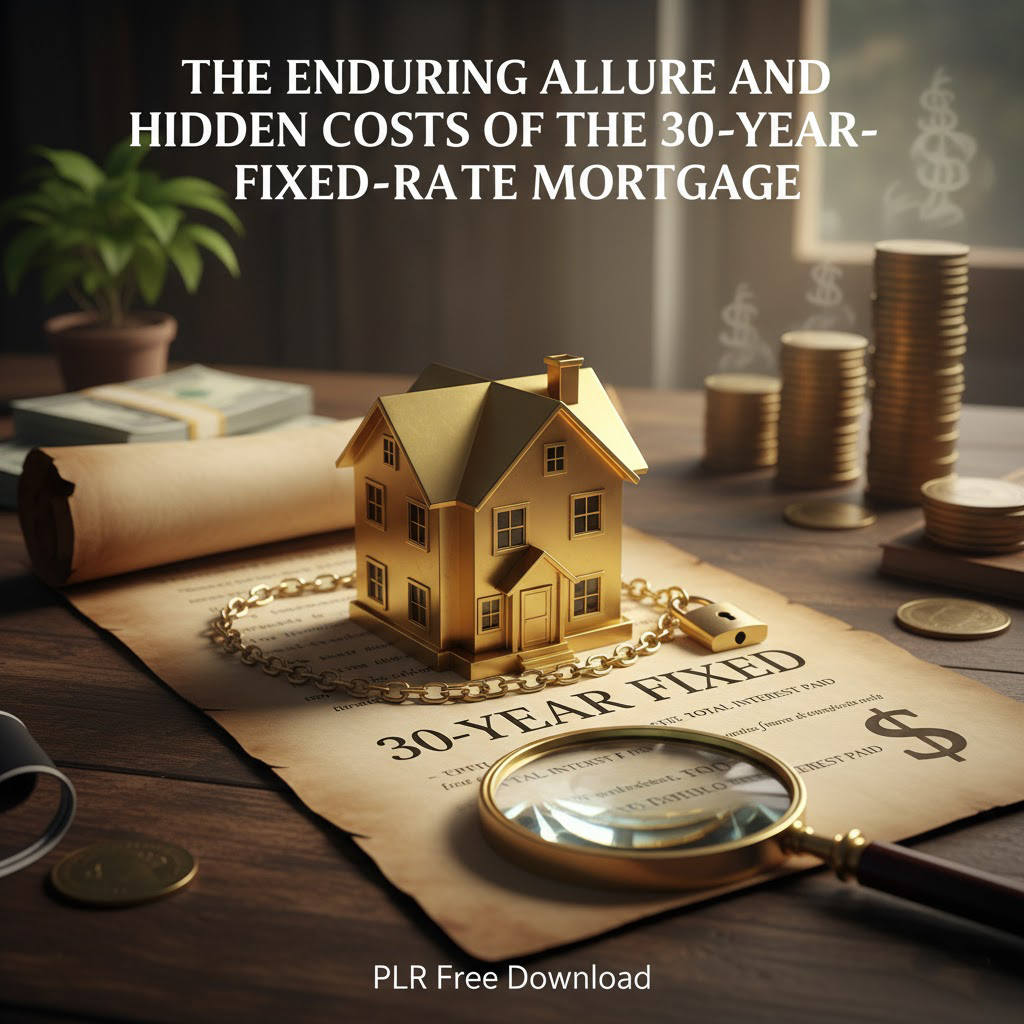

The 30-year fixed-rate mortgage stands as the undisputed titan of home financing in America. It is more than just a loan product; it is a cultural touchstone, the foundation upon which generations have built the dream of homeownership. For most prospective homeowners, the choice of a 30-year term is an immediate and unquestioned decision. It offers a powerful combination of affordability and stability, qualities that are profoundly appealing in the volatile world of personal finance. Yet, beneath the comfort of low monthly payments lies a significant trade-off—a substantial increase in the total cost of borrowing. Understanding this balance is critical to ensuring your 30-year commitment truly serves your long-term financial goals.
Section 1: The Unmatched Appeal of Stability and Affordability
The primary, most compelling benefit of the 30-year fixed-rate mortgage is its unparalleled affordability. By spreading the repayment of the loan principal over three decades, the lender significantly reduces the required monthly mortgage payment. This reduction is often the difference between qualifying for a loan and being priced out of the market, or between purchasing a modest starter home and securing a more comfortable, long-term property.
Crucially, the “fixed-rate” component offers an essential shield against future financial uncertainty. Once the loan is finalized, your interest rate is locked in for the entire 360-month term. In an economic environment characterized by inflation and unpredictable interest rate cycles, this certainty is invaluable. Your payment for principal and interest remains constant, allowing for predictable budgeting decades into the future. Even if interest rates soar years after you purchase your home, your monthly housing expenditure remains static. This stability empowers homeowners to plan for major life expenses, such as retirement savings or their children’s college education, without the stress of potential spikes in their largest monthly obligation.
Furthermore, a 30-year term offers a built-in financial flexibility. Because the required payment is lower, it provides a larger cushion of available cash flow. This extra money can be utilized to build an emergency fund, invest in tax-advantaged accounts, or tackle other high-interest debts. Essentially, the 30-year term offers a low required payment while retaining the option to pay more. If you experience a financial windfall, you can accelerate payments without penalty, effectively reducing the life of the loan and saving on interest. However, if circumstances become challenging, you only ever have to meet the lower required minimum.
Section 2: The Amortization Schedule and the Interest Penalty
While the benefits of the 30-year loan are immediately apparent, its primary drawback is the colossal amount of interest accrued over its lifespan. This is the hidden cost of affordability.
A mortgage works on an amortization schedule, which dictates how your monthly payment is split between paying down the loan principal and covering the interest. In the early years of a 30-year mortgage, the vast majority of your payment—sometimes 70% or more—goes directly to interest. Equity accumulation is incredibly slow in the first decade. This structure means that even after five years of making payments, you may have barely made a dent in the principal balance.
To illustrate the difference, consider a $300,000 loan with a 6% fixed interest rate:
- 30-Year Loan: The monthly payment is approximately $1,798. Over 30 years, you will pay roughly $347,208 in interest.
- 15-Year Loan: The monthly payment is approximately $2,532 (a $734 difference). Over 15 years, you will pay only about $155,772 in interest.
The choice of the 30-year term, in this scenario, costs the borrower an extra $191,436 in interest alone. This nearly doubling of the total borrowing cost is the primary reason financial advisors often urge borrowers to consider a shorter term if their budget allows. The longer you take to pay off the principal, the more opportunities the bank has to charge interest on that remaining debt.
Section 3: Strategic Considerations and Opportunity Cost
The decision between a 30-year and a 15-year mortgage often boils down to a debate over opportunity cost and risk tolerance.
Proponents of the 30-year loan argue that the increased interest paid is a worthwhile sacrifice for the cash flow flexibility. They contend that the money saved on the lower monthly mortgage payment is better invested elsewhere, such as in the stock market, which historically offers an average return exceeding the typical mortgage interest rate.
- The Investment Strategy: If your 30-year mortgage rate is 6% and you believe you can consistently earn an 8% or 10% return in a diversified investment portfolio, then the financially optimal move is to take the lower monthly payment and invest the difference. You are essentially using the bank’s money at a lower rate than what you expect to earn elsewhere. This strategy is referred to as leveraging.
- The Debt-Aversion Strategy: Conversely, many individuals prioritize financial peace of mind. For them, the certainty of becoming debt-free sooner with a 15-year mortgage outweighs the potential for higher investment returns. They prefer the guarantee of saving thousands in interest rather than risking market volatility.
For many homeowners, the best approach is a hybrid: opting for the low required payment of the 30-year fixed mortgage but voluntarily making extra principal payments as if it were a 15-year loan. This strategy provides the safety net of a low minimum payment while offering the substantial interest savings of a shorter term, should finances remain stable.
Section 4: The 30-Year Loan Versus Alternatives
While the 30-year fixed rate is the benchmark, it is helpful to understand the primary alternatives:
- The 15-Year Fixed-Rate Mortgage:
- Pros: Significantly lower total interest paid; faster equity build-up; generally offers a slightly lower interest rate than the 30-year.
- Cons: Much higher required monthly payment, putting more strain on monthly cash flow.
- Best For: High-earners, those nearing retirement, or those with significant savings who prioritize becoming debt-free quickly.
- Adjustable-Rate Mortgage (ARM):
- Pros: The initial interest rate is significantly lower than a 30-year fixed rate (e.g., a 5/1 ARM has a fixed rate for the first five years). Lower initial payments.
- Cons: After the initial fixed period, the interest rate can change annually, potentially increasing the monthly payment dramatically. Introduces financial risk.
- Best For: Individuals who plan to sell the home or refinance before the introductory fixed period expires (e.g., within 5, 7, or 10 years).
Ultimately, the enduring popularity of the 30-year fixed-rate mortgage is a testament to its core strengths: stability and accessibility. It is the ideal product for the first-time buyer who needs the lowest possible monthly payment to afford a home, and for the family seeking the predictability necessary for long-term financial planning. While it comes at a higher overall cost of interest, it provides a crucial safety net—a foundational piece of financial planning that ensures the dream of homeownership remains manageable, even when life throws unexpected challenges your way. The key is to choose the path that aligns not just with what you can afford today, but with your deepest feelings about debt, risk, and financial security.